


Reuse of raw materials and waste streams, both in-house and from external sources
For the production of all facing bricks and clay pavers, the brickworks uses almost 50% recovered raw materials released from local infrastructure projects and construction sites. This circular use of raw materials has been applied for many years and provides a diverse mix of ingredients for a unique finish in facing bricks and clay pavers.
To mark its 160th anniversary, Vande Moortel launched its Circular Brick, in 2024. This category is a prime example of the circular economy and responsible material use within the industry. This circular facing brick promotes circularity through the recycling and reuse of secondary raw materials, enabling the production of an entirely new facing brick. The concept partially grew out of participation in the Circular Construction Green Deal. For this facing brick, a specific batch is produced exclusively from available unextracted raw materials. In other words, this production consists 100% of raw materials sourced from our own residual streams, infrastructure projects, or other production units. The colour, composition and quantity of bricks are thus fully determined by the secondary raw materials available at that particular time.
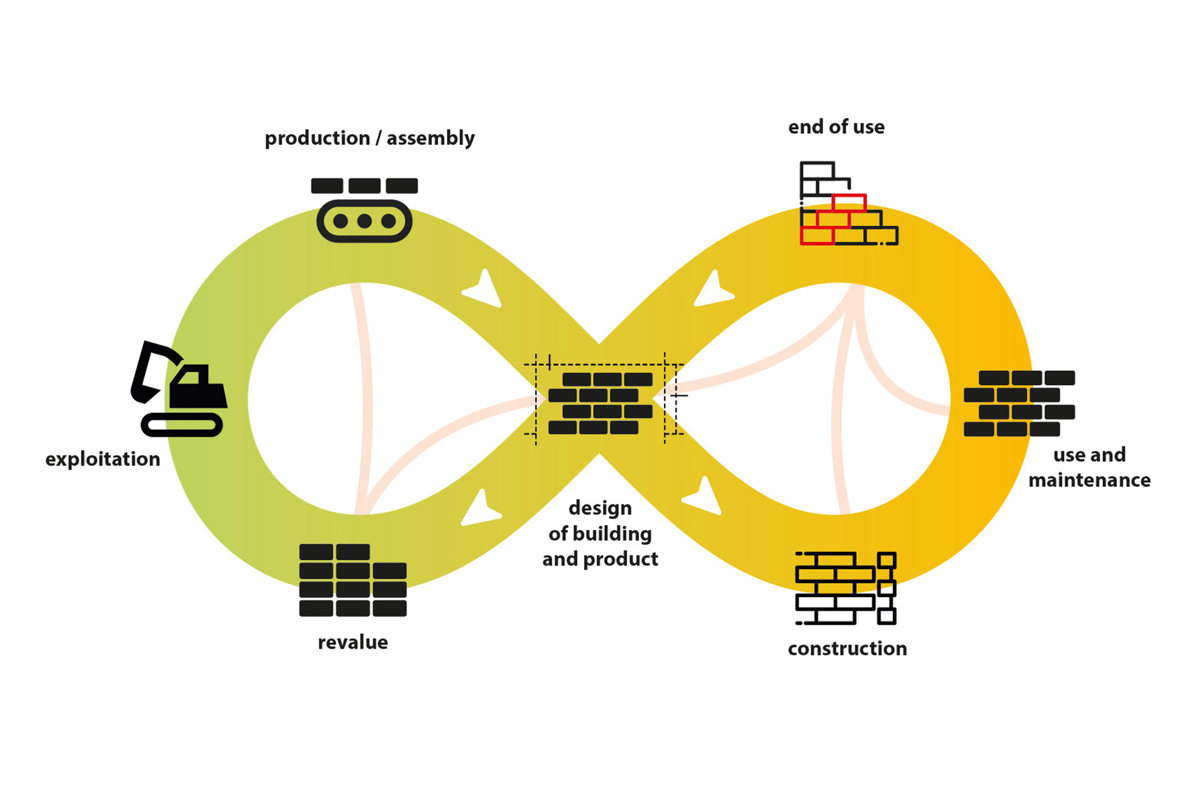
Recovery of finished product or “primary circularity”
When an old building is dismantled, many materials, particularly old façade bricks, can still enjoy a long remaining lifespan in new use, so it would be a shame not to make optimal use of them. The recovery and reuse of old bricks, known as reclaimed bricks, is gaining ground with an eye to circularity. There are numerous examples where reclaimed bricks can be reused in various applications, either on the same site or elsewhere, for restoration or new-build projects, for both traditional and contemporary schemes.
Clay pavers also possess a highly circular character and can be reused multiple times, either on-site in a renovation or in another project. At the Grote Markt in Sint-Niklaas, for example, the existing Vande Moortel clay pavers were carefully removed and reused in the market’s new layout. Of the more than 1.2 million clay pavers from the old Grote Markt, over 60% will be reincorporated into the new project, particularly along the edges of the square and the connections with the surrounding streets. Any bricks not reused in the renovation will be brought back onto the market by Vande Moortel as reclaimed clay pavers, a principle is also referred to here as “primary circularity”.
Recovery via urban mining or “secondary circularity”
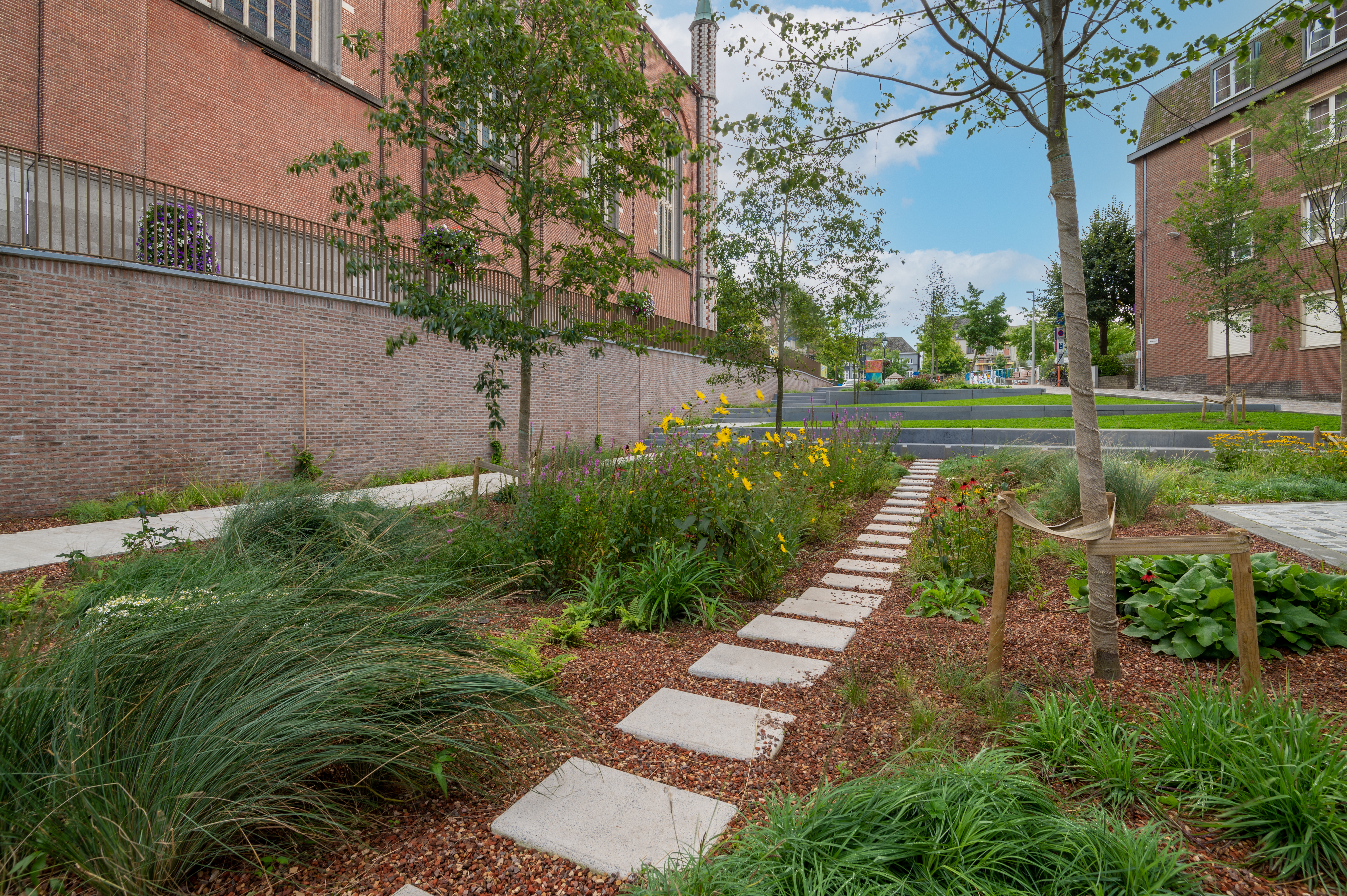
In addition to the reuse of products in their original function, we also give used facing bricks and clay pavers a new purpose, including through “urban mining”. In this “secondary circularity”, bricks are broken down into coarse aggregate, so the material can then be repurposed in the construction of paving and as a permeable infiltration layer. Even brick rubble from demolition sites can be recycled and reused as a sub-base layer. The churchyard of St Gertrude’s Church in Wetteren is an excellent example of this approach, where crushed facing bricks and clay pavers have been used as a permeable infiltration layer. The car park at the Vande Moortel site also incorporates crushed brick as a paving material. These ground clay pavers were laid atop a permeable substructure. A circular application of clay pavers that can no longer be reused as such, meaning that, in principle, a clay paver should never have to end up in construction waste. Even for tennis courts, crushed brick is used as gravel, and circular recovery can also be applied here.
This way, the waste stream is minimised and materials are used circularly in two ways: by reusing products in their original condition, or by giving them a second life, with brick rubble used as an infiltration layer or construction debris as a sub-base layer.
Construction using circular masonry
Circular approaches can also be applied in the use of facing bricks in masonry. To improve the circularity of masonry, alternative mortars are being developed using natural and environmentally friendly raw materials. In addition to the bricklaying mortar, a suitable joint mortar is also being investigated, with the aim of including both in a library of circular building materials. All mortars are evaluated on their composition, technical performance and workability. The ultimate aim is for masonry that can be easily dismantled at a later stage, so that the materials remain fully reusable for new façade constructions.
Reuse of water
For the production of our facing bricks and clay pavers, only surface water is used. We do not make use of mains water. We also implement zero discharge of water, meaning that all water streams in production are fully reused.
